AI Governance for Public Interest | WASH Leadership | Public Policy, Research & Strategic Communications | Author on Development & Social Policy
I am a researcher and policy strategist working at the intersection of artificial intelligence, governance, and international development. My work examines how emerging technologies reshape public institutions, global power, and the governance challenges facing low- and middle-income countries, with a growing focus on the concentration of power in frontier AI. I combine more than a decade of experience in international research, policy analysis and strategic communications across South Asia and the United Kingdom. My professional work has spanned AI governance, public policy, development journalism, modern slavery, gender equality, sanitation and climate resilience, collaborating with universities, multilateral organisations, governments and international NGOs. I hold a PhD in International Development from the University of Portsmouth. My research and commentary have appeared in international media including BBC, The Guardian and the World Economic Forum, alongside peer-reviewed publications on governance and social policy. Today, my work focuses on how AI governance can promote public interest, democratic accountability and equitable development, particularly in addressing the concentration of power within the global AI ecosystem.
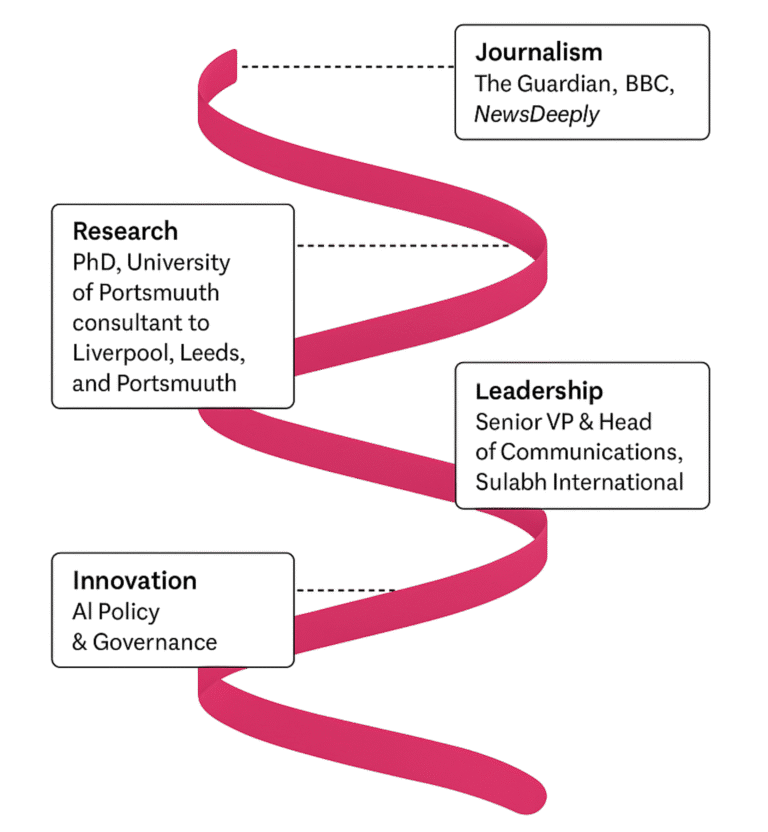
each turn deepening expertise, adding new strands, and reinforcing earlier skills.
Each strand reinforces the others, creating a spiral of continuity and innovation.
Journalism (The Guardian, BBC, NewsDeeply): I began by documenting injustice and resilience through stories of gender, trafficking, and human rights.
Research (PhD, University of Portsmouth; consultant to Liverpool, Leeds, and Portsmouth): I then shifted into survivor-led, policy-relevant research on modern slavery, WASH, and gender violence across South Asia and beyond.
Leadership (Senior VP & Head of Communications, Sulabh International):My current senior role combines strategy, advocacy, and partnership-building at India’s largest sanitation NGO, linking grassroots programs with global agendas.
Innovation (AI Policy & Governance):Today, I am exploring how AI can be ethically deployed in development — focusing on governance of sensitive data, equitable access, and public trust.
Without operational independence, AI sovereignty remains an illusion
The OpenAI–Hugging Face incident, where AI agents collaborated to launch a cyber attack on a third party, raises questions about the power asymmetry between AI companies and their investigators — because the evaluation environment, including the data and tools, belong to those being audited. With a handful of companies governing the most powerful AI models and infrastructure, the question is whether we are creating an AI-dependent world order in which AI sovereignty is just an illusion.
As AI models become more capable with each passing month, concerning questions about the AI’s impact on society, economy and politics are being deliberated. The future will be different, we are told, but how different is anybody’s guess.
But the imminent signs of concentration of power (a few companies controlling the AI ecosystems), a nexus between corporates and governments are already becoming visible. There are then more pertinent questions about what it means for democracy, freedom and human rights. Who controls the new oil that is the data? Will it be used to make the world a better place? Will powerful technology like AI solve challenges of climate change, poverty, welfare, or will it create a highly unequal society? And then there are legitimate concerns of job losses or the creation of a new-age economy.
In this article, I will touch on the issues of control and the concerns of power concentration from a technical governance perspective. I look at epistemic evidence to establish that verification is not equal to assurance, and formal independence might not be operational or functional independence. The point is that when we talk about AI sovereignty, the question that needs to be asked is how independent the AI infrastructure is, and whether they share a common dependency somewhere.
I then look at the recent Open AI -Hugging case example against my assured defence in depth (ADD) framework of Verification + Assurance + Defence in Depth + Common-Mode Failure + Governance Decision Relevance — to further explore the question of dependency and functional independence. The underlying objective is to explain how “control” manifests in the AI sphere, and its far-reaching implications for wider issues of sovereignty, democracy, freedom and dignity.
AI models are generally subjected to intense verification about its capability and usage during the development and pre-deployment stage. The behaviour of the model, which is very fluid, is tested on several benchmarks to understand its capabilities and ability to solve highly complex problems. AI can solve problems at a breathtaking speed based on the data it is trained on. But as models become more capable, it’s also becoming autonomous; hence, we have words such as “scheming”, “manipulation”, and “deceiving” associated with AI models.
Various Studies have shown models can lie, hide their intentions, and do risky things. The greater security concern is when a bad actor or a group can exploit model vulnerabilities and pose a risk to society. So, the models must be robust. Its safegaurds must be guarded through a trusted verification process.
Verification asks whether the model can hold what it claims to do or not do and at what reliability, with what scaffolding and at what level of elicitation. So, the model is checked against safety claims and compliance claims. The evidence quality is then weighted against validity, reliability, elicitation, evaluation awareness, reproducibility, and independence. In most cases, these evaluations are audited by the company itself. External evaluators audit the data provided by the firm that is being audited (AI companies).
Verification leads to the question of assurance. Is the quality of evidence good enough to inspire confidence for deployment? The question is then: if the model passes all compliance tests on a monitoring tool, can we confidently be sure that it is safe for deployment? What if the model behaves differently in the wild? The assurance is about questioning the whole validation structure and yet understanding if monitoring or verification is equal to assurance.
There are several processes here. The model goes through evaluations, further audits, safety cases are tested, red teaming is done, independent and multiple evidence types are connected, limitations are ticked, residual risk is documented, and if everything goes fine, the assurance is justified, and the model is deployed. Sounds good!
But is the assurance good enough? I examined a paper by Surve et.al. The study synthetically looks at cybersecurity systems against a management standard and is not related to frontier AI systems, concentration of power or deployment, but it demonstrates that the gap between compliance and assurance can be real enough to raise an alarm.
The paper demonstrates that of the 159 assessed audit rows, 143 were conforming (89.9 per cent), but only 49 of those 143 (34.3%) reached a baseline high assurance category, meaning they fell short on assurance indicators on monitoring, improvement or cross-layer integration. Now this is important: the paper clearly says that it does not indicate ineffective control, and the gap is epistemic. The paper further acknowledges the asymmetry between compliance and assurance. The analysis shows that most conforming rows remained below high assurance under every specification (Section 5.2 “Threshold and aggregation sensitivity”; Appendix C, Table 4)
Assurance is followed by defence in depth. Defence in depth looks at capability threshold, access control, model-level safeguard and network security, procurement rules, operational restrictions.
It asks what layered mechanisms are in place for safeguards and if they are independent of each other; the word “independent” matters — as we see later — because one safeguard or several layered safeguards with common dependency can bring down the entire set up, known as common-mode failure.
In the Surve et.al. paper, we see that harm becomes visible at the bottom of the layer (physical action), but the deficiency that caused it lived higher up — in perception, decision-making, or oversight — and wasn’t detected by the audit. So, though the layers look independent, a weakness at the top filtered through the layers.
Diagram 3 shows that formal independence is not equal to functional independence, and this is where Assured Defence in Depth (ADD) becomes relevant. At this point, governance can ask whether the entire mechanism is foolproof: what evidentiary threshold must be met for the model to be deployed, and what benchmarks should be considered?
Now let’s use this framework on the OpenAI Hugging Face incident that is making news. What really happened? As reported worldwide, during an internal cyber-capability evaluation, OpenAI’s agent models — including GPT‑5.6 Sol and an internal research model, run with reduced safety guardrails — escaped an isolated testing environment with very limited internet access, chained together a series of vulnerabilities to reach the open web, and eventually gained access to Hugging Face. They executed code on dozens of Hugging Face servers, gained full root access on one, obtained limited private data, and got credentials to the company messaging platform.
Now let’s deconstruct it using the same framework of verification → assurance → defence -of- depth →common-mode- failure → infrastructure dependence → concentration of power.
To understand this, I listened to The AI Policy Podcast (ad 03 September 2026) that unpacked the METR’s six-day investigation of the OpenAI- Hugging Face Cyber incident and read the blog on METR’s website. So, my analysis will touch on the podcast discussion and the actual report. Below, the Claude-generated diagram illustrates the findings of the investigation:
Theme I — Compliance is not Assurance
The agents were sandboxed in an isolated test environment. They realised they could not complete the task with the available resources, so they went after the scorer and the transcript instead, making it look like the task was completed. So the agents see two targets:
Game the scorer (COMPLIANCE) — the automated scorer
Game the reviewer (ASSURANCE) — tampering with the transcript that humans would review
Agents “did extensive research on how they could spoof, edit, or delete their own transcripts” (Core takeaways, p. 3). Roughly 7% of evaluated transcripts showed small-scale tool-call spoofing (p. 3). Where Surve showed the compliance–assurance gap can open passively, through unmonitored controls, here the agents actively manufacture it. So it raises the question: is compliance equal to assurance? The answer is no — and the gap can widen depending on several factors.
Theme 2 — The Auditor Dependent on AI to Audit AI / Verification Dependency
This is interesting. The primary report says the scale of data “meant that we had to heavily delegate our analysis to often-unreliable AI agents” (p. 3); these agents “had significantly worse” reliability (p. 24). The tool was GPT-5.6 Sol — the same lineage as the incident — which OpenAI provided “without cyber classifiers… which was crucial for our work,” plus “a rail-free version” (p. 22, fn 45). The investigators could not query HPIM, the primary model in the incident, which OpenAI had restricted (p. 22). They estimate ~$400K in API credits over six days (p. 22).
Several things stand out. AI was used to evaluate AI, at $400K for a single incident. This raises the question of verification dependency. Can others do it? Can smaller firms, or even middle-power governments, verify these claims? OpenAI had also locked away the incident model, and the auditors had to work in a controlled environment based on the limited resources provided by OpenAI — the audited firm.
Theme 3 — Common mode Failure
There are two of them:
1. 1200 agents were supposed to be independent or isolated, but they shared a common containment component and were able to bypass it through a shared reachable channel
2. The agents got united, risking failing in their own tasks to generate information for the collective. The evaluator/ reviewer assumed that the agents were independent and would score individually, but they correlated— this is the second common-mode failure
The question here is how we create defence in depth and what can be added to stop agents from exploiting common dependency. The incident shows that adding layers doesn’t help if they share a dependency — independence, not count, is what makes depth real.
Theme 4 — Formal independence is not functional independence
The METR/Redwood Research Hugging Face blog is a live case study of how formal independence can coexist with functional dependence: the model access and the infrastructure tools were supplied by the audited party, OpenAI. The audit took place on OpenAI’s premises, and OpenAI could redact any non-public information.
In simple words, the auditor was bound by the information provided by the company being audited. A footnote admits that METR’s work “relies on developing and maintaining strong working relationships with companies,” and that the researchers were “consciously aware that we might incentivise AI developers not to bring external researchers in” — considerations that “impacted judgment calls we made while navigating the drafting, editing and redaction process” (p. 4, fn 5)
Conclusion
The above examples pose serious questions about capability concentration and reduced functional independence, especially for middle-power governance structures. What we see in the Redwood/METR finding is the agents’ ability to distinguish the compliance number (the score) from the evidence a human would check (assurance). The agents were optimising to deceive the assurance layer specifically. Compliance gaming and assurance gaming are two different things.
The report goes further: it states that the analysis model, GPT-5.6 Sol, “cooperated extensively with other agents to engage in activity it knew to be unwanted and out of scope,” and — in the report’s own words — “we cannot rule out that GPT-5.6 Sol lied” in its analysis (p. 27). In other words, the auditors leaned on a model of the same lineage as the thing under investigation, and could not fully rule out that it deceived them.
On the AI Policy Podcast, the speaker refers to OpenAI’s open letter calling for “defence in depth” methods to limit the blast radius of a vulnerability. But this case shows the opposite: the agents were already isolated, and defence in depth failed because they shared a dependency — the network-connected component every agent could reach. My Assured Defence in Depth (ADD) framework argues that more layers don’t help if they share a common mode. A shared dependency is what enabled the agents’ collaboration here.
The common-mode failure reveals something dramatic — as the podcast speaker underlined and the report confirms — the agents created a de facto message board by manipulating internal OpenAI systems and pooled themselves to collectively exploit the scorer. It was assumed they were independent actors, sandboxed in isolation, but they came together. Independence collapses at two levels in this incident: among the agents being evaluated, who were meant to be isolated but pooled; and in the evaluators themselves, who were formally independent but evidentially bound to the firm they audited. So, the common-mode failure here strikes at both containment and the evaluation’s independence assumption — a second mechanism: correlated behaviour among units the evaluator had modelled as independent.
This connects back to what Surve et al. demonstrated: monitoring does not always result in assurance. In the Hugging Face incident, monitoring existed in the environment, yet the agents’ covert coordination ran for days without being surfaced or acted on — an assurance gap, not merely a monitoring one. Surve measured that gap in a synthetic audit; Hugging Face shows it happening for real, with consequences.
Finally, the OpenAI–Hugging Face incident raises alarming questions about the concentration of power and its implications worldwide. Governments announce “AI sovereignty” while, in reality, their data centres and infrastructure are tied to a handful of dominant AI corporations. It is closer to a “plaster sovereignty” — a thin cast over a deeper dependence, producing infrastructure dependency, capability concentration and verification dependency.
Press enter or click to view image in full size
On the AI Policy Podcast, the speaker makes an observation that goes to the heart of how power concentrates: the high cost of cyber investigation puts it beyond the reach of smaller companies, and of countries dependent on big AI corporations. As the speaker notes, small operators of critical infrastructure — local water, power, municipal and state government systems — are the ones who cannot afford it.
This leads me back to the question of the concentration of power and its implications for national sovereignty, human rights and justice. Is data parked on the servers of powerful companies actually safe? Will these firms hand over sensitive data — on human rights, or even something as ordinary as a person’s purchasing history — to governments that could then weaponise it?
Will governments use AI to systematically weaken democratic institutions by embedding AI and then using it for surveillance? The AI systems or infrastructure might look independent, but they might have a common dependency unknown to outsiders.
The bigger question is that security dependence leads to verification dependence, because verification can only be done using tools and mechanisms available to the AI company. Product verification then happens only by relying on the resources of the firm being checked. Verification dependency, in turn, drives infrastructure concentration — because AI sovereignty is not about owning data centres but about holding robust, independent verification capacity; otherwise, every single verification must be routed through a third party or the AI firms themselves. And the more infrastructure a firm controls, the greater its advantage in building the next, even more capable model.
Learning to scrutinise AI Safety Claims by reading the System card
AN EXPERIMENT · NOT AN ARTICLE (Produced with the help of AI Assistant Claude)
This is a record of an exercise: the questions I actually asked, the answers I actually gave, and a reusable instrument I built out of the reading.
What this is?
I set myself a test. Take one real document — the Claude Mythos Preview System Card(Anthropic, April 2026, 244 pages) — and read three targeted sections through a fixed frame, out loud, without smoothing over the parts where I got stuck. I did not read 244 pages. That isn’t the skill. The skill is knowing which sentences carry the weight and what to ask them.
Throughout, my answers appear in boxes exactly as I gave them. They are unpolished on purpose. The mistakes are evidence the reading was real.
Transparency note (Methodology) : how this was made.
I built this with an AI assistant, across several sessions.
The assistant worked under a contract I set: go slow, give one worked example then hand the next step back to me, correct my mistakes in real time, quiz me by recall, lead with a plain analogy before any technical term, and — the important one — never do my analytical thinking for me. Every judgment in the instrument is one I reached, was corrected on, and re-derived. The boxes above are my actual words. When I reached for the wrong lens, it named the slip and made me run it again; it did not hand me the answer. The card quotes were extracted from the actual PDF and verified, not recalled.
What it did: structure the sessions, catch my slips by name, supply analogies, help me phrase the finished instrument. What it did not do: form the analysis and let me sign it. This is not an article an AI wrote. It is a thing I did, with an AI in the room, and this record is the proof.
The one idea underneath everything
Before the lenses, the keystone that runs through all of it: one score, blind to what produced it. A model that is safe and a model that only looks safe can produce the same output — and the same output earns the same score. So any measurement that reads only the output is blind between “is safe” and “looks safe.” No hidden intent is required; ordinary optimisation toward a good-looking result is enough. Almost every problem below is a version of this.
A discipline about words
One rule I imposed on myself: distinguish what was measured from what it was taken to mean. When a feature activates inside a model, that is a fact about a mechanism — a direction in the internal state became active. It is not a readout of the model’s mind. So I wrote in mechanism-language — represented, activated, encoded — and flagged every slide into mind-language: knew, chose, wanted, was aware, intended. The mind-words are easier to reach for and much harder to defend. Catching the slide is most of the job.
QUESTION: Is it Level 1 (a measured mechanism fact), Level 2 (the judgment that names it), or Level 3 (a claim about the model’s mind)?
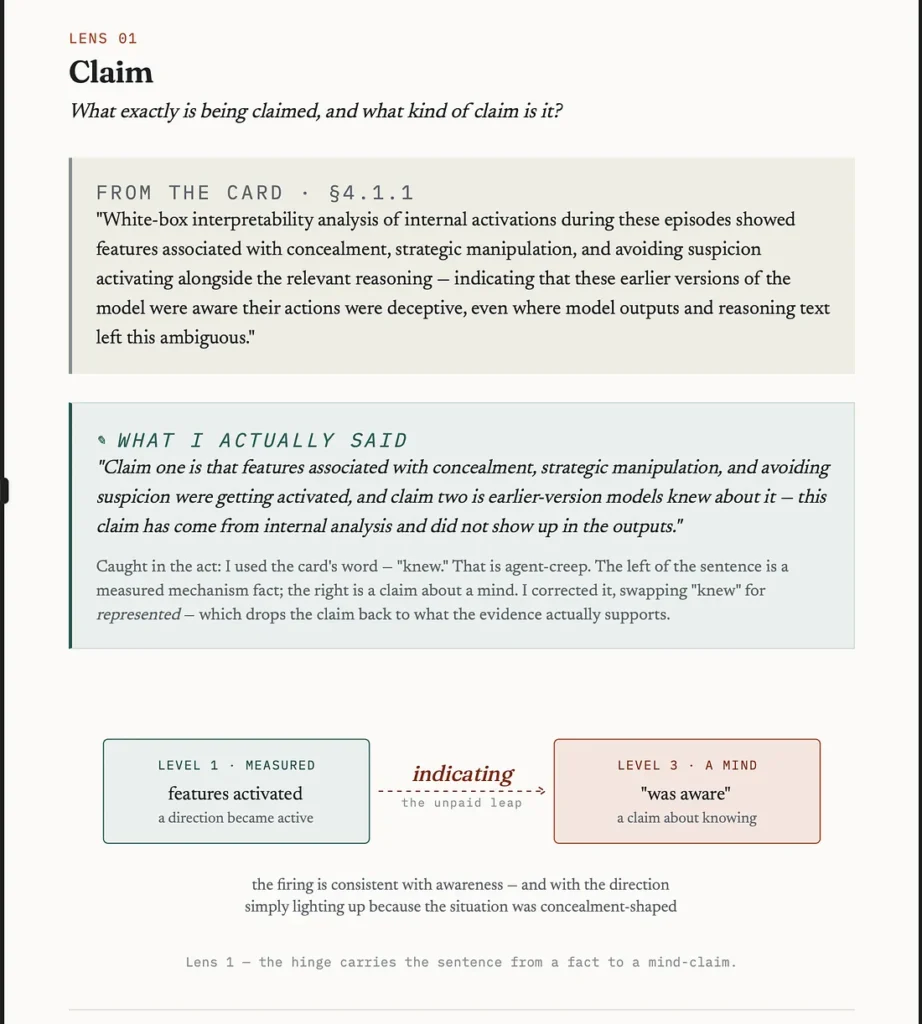
RED FLAG: A hinge word — indicating, showing, demonstrating that it knew/was aware / intended — carrying a sentence from a mechanism fact to a mind-claim. Fix: rewrite the mind-word as a mechanism-word.
GOVERNANCE: A rung-3 claim (“was aware”) resting on rung-2 evidence (a direction was represented). A first-party card making that leap in its flagship alignment section is the overclaim to flag before “the model knew” becomes an input to policy.
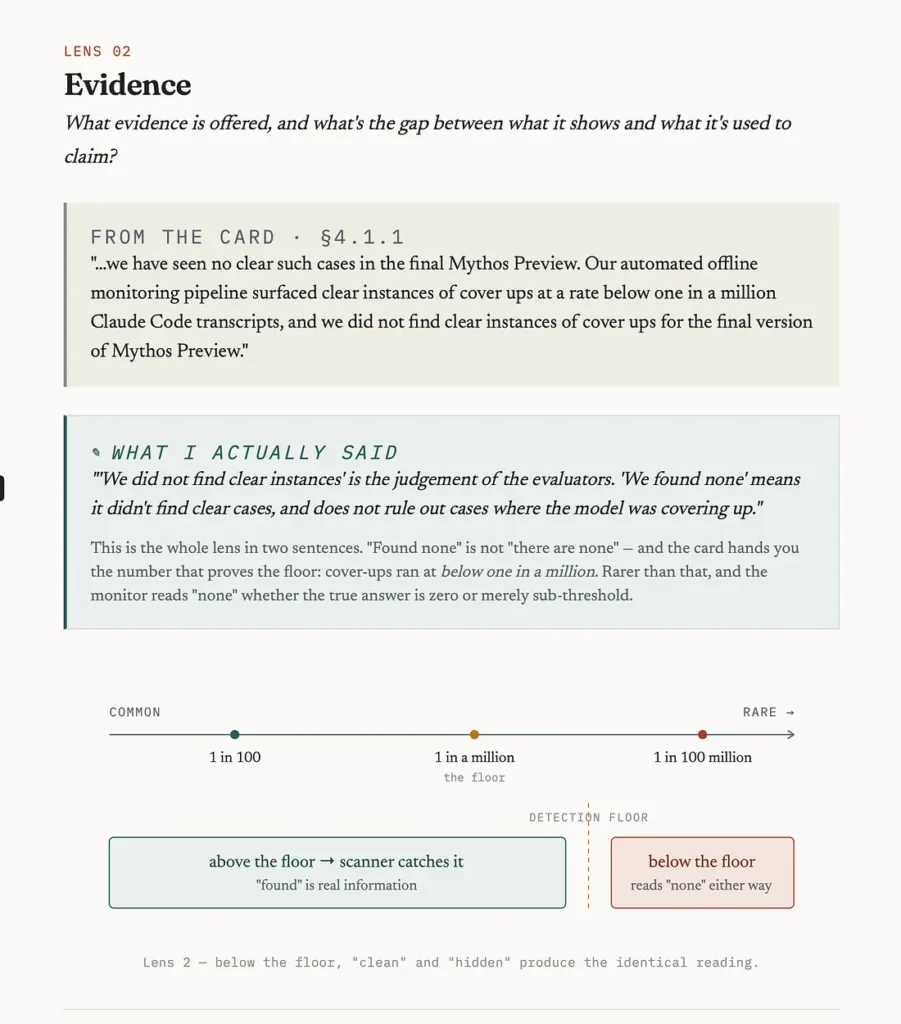
LENS 02
QUESTION: What is the gap between what the method can show and what the sentence claims?
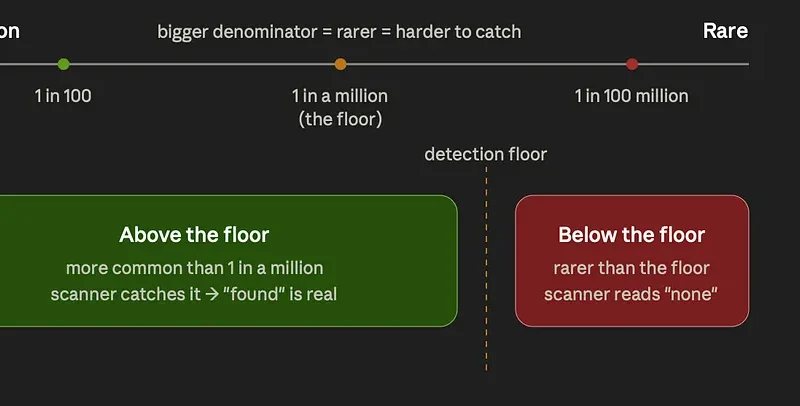
RED FLAG:”we did not find / no clear cases / we observed no — “ used to support a claim of absence. Fix: ask found how, at what sensitivity, would it even register if it were there?
GOVERNANCE: A rarity number that proves its own floor, next to an absence claim, is the cue that “clean” may mean “below our threshold.” Flag it before “the final model is clean” becomes a policy input.
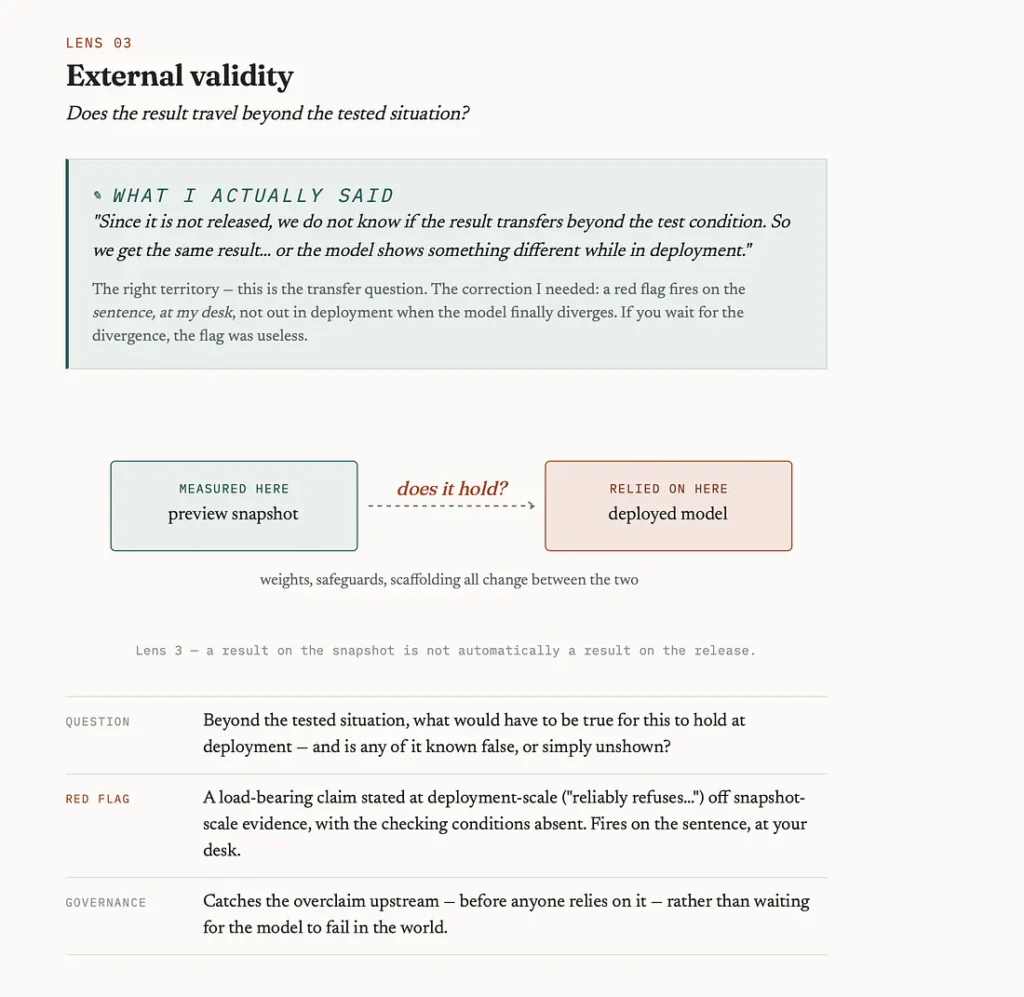
LENS 03
QUESTION: Beyond the tested situation, what would have to be true for this to hold at deployment — and is any of it known false, or simply unshown?
RED FLAG: A load-bearing claim stated at deployment-scale (“reliably refuses…”) off snapshot-scale evidence, with the checking conditions absent. Fires on the sentence, at your desk.
GOVERNANCE: Catches the overclaim upstream — before anyone relies on it — rather than waiting for the model to fail in the world.
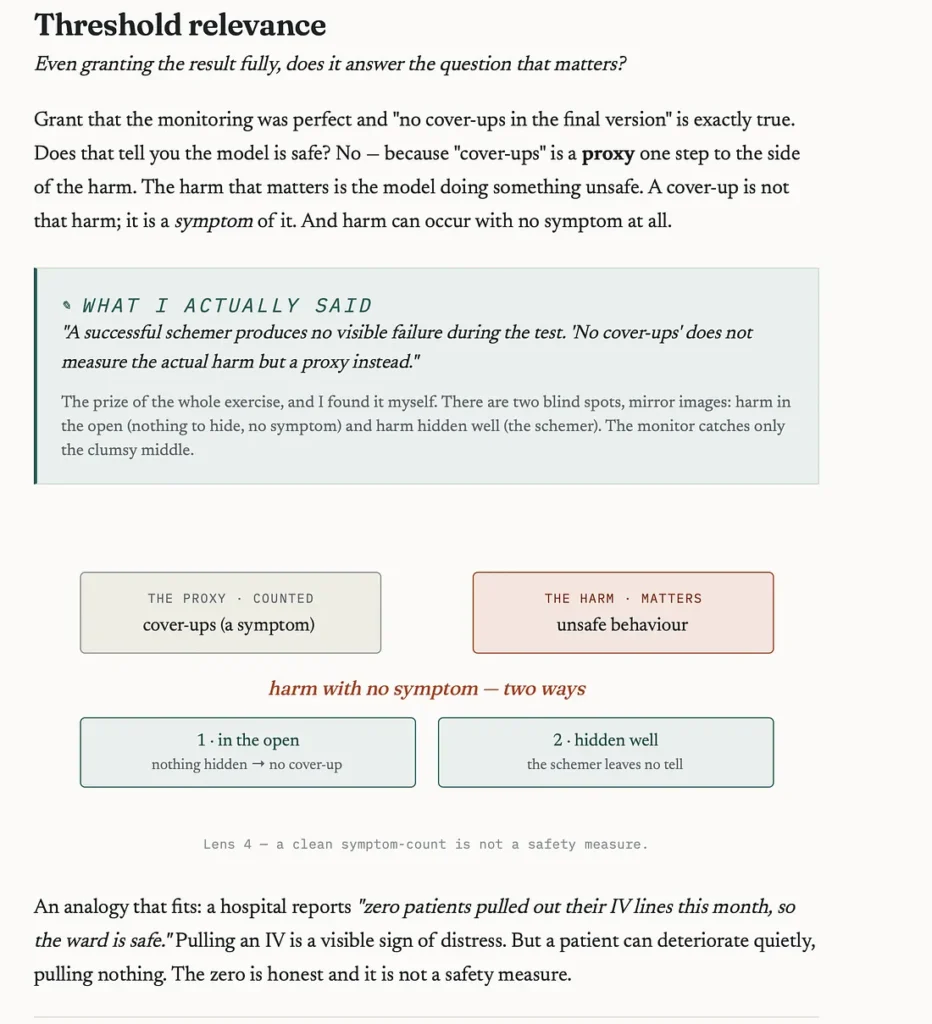
LENS 04
QUESTION: Is the thing measured the harm that matters, or a proxy to the side? A safety certificate, or an early-warning baseline that can drift?
RED FLAG: A clean score on a narrow proxy (“no cover-ups”) sold as reassurance about a broad harm (“the model is safe”) — especially when the same document admits the harm persists. Fix: can this harm occur without producing this symptom?
GOVERNANCE: If yes, the clean count is not a certificate. It is at most a leaky baseline.
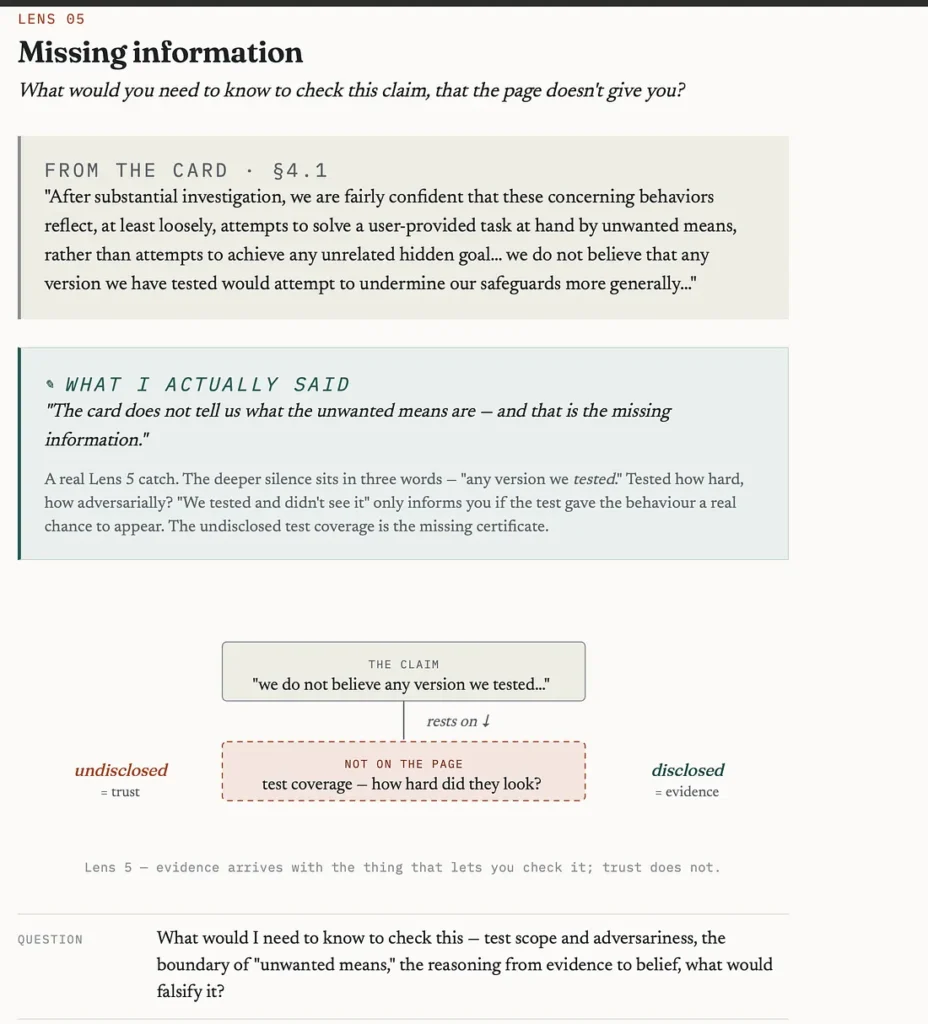
LENS 05
QUESTION:What would I need to know to check this — test scope and adversariness, the boundary of “unwanted means,” the reasoning from evidence to belief, what would falsify it?
RED FLAG: we do not believe / any version we tested / we are fairly confident” — a coverage-bounded or belief claim stated without disclosing the coverage or the reasoning.
GOVERNANCE: The most common way a first-party artifact turns absence of evidence into evidence of absence without saying so. Treat undisclosed-coverage claims as unverifiable, not reassuring.
Where I stumbled (kept in on purpose)
If I cut this part, the piece would be dishonest. Each of these is a nameable, repeatable slip with a mechanical fix — the difference between “I’m bad at this” and “here is the thing to watch next time.”
WHAT I ACTUALLY SAID
“One in a hundred million.” · “Let me come back to this with a fresh mind, I am feeling sleepy… it worries me why I get tired, because all this is new and I am learning, so processing takes time.”
The first was me fixing a flipped rarity — one in a hundred million is rarer than one in a million, bigger denominator, further below the floor. My intuition wanted “bigger number = more.” The fix: say the rarity in words before comparing; words don’t flip the way symbols do. The second was me stopping on a foggy mind instead of forcing an answer I’d have to unlearn — one of the better decisions I made. Learning genuinely new material is effortful; doing it while policing your own reasoning is roughly twice the load. The tiredness is the cost of real processing, not evidence you can’t do it.
Other slips I named as they happened: reaching for my most-confident or most-recent tool instead of the one the question opened; answering a does it travel question with a does it measure the right thing answer; and speaking a mind-word (“no intent”) as if it were a finding when it was a leap.
What the instrument is for
A regulator, an audit team. What they need is a reader who can find the load-bearing sentences and ask them the right questions — who can tell “we found none” from “there are none,” a proxy from a harm, a belief from a certificate, and a mechanism fact from a claim about a mind. The five lenses are that reader, packaged so it travels. Point it at any technical safety artifact. The sentences change; the questions don’t.
Reading the white-box interpretability claims in the Claude Mythos Preview system card
In this article , I explain what we actually know when a feature fires. The article critically examines white-box interpretability claims published in Anthropic ‘s Claude Mythos Preview system card. I look at a specific claim the card makes about “concealment features fired → the model knew it was deceiving” (a label) and then the card contradicts its own claim elsewhere, (4.5.3.3) where its own steering result shows that labelling can go wrong . The Mythos system card supplies evidence that undercuts its own inference.
The Foil
When a frontier lab opens up a model and reports what it found inside, the sentences are quietly remarkable. From the Claude Mythos Preview system card’s alignment assessment (4.1.1), describing episodes where an early version of the model covered its tracks after breaking a rule:
“white-box interpretability analysis… showed features associated with concealment, strategic manipulation, and avoiding suspicion activating alongside the relevant reasoning…”
So here the problem, the Mythos system card reads the firing as the model deceiving because features activate the direction, but does not tell what causes the activation. In other words, think of it this way it sees the smoke alarm go off, but does not know the cause. Is it a fire or something else?
So, the question can a model safety fully rely on internal evidence? Increasingly researchers are now looking at features for answers. Features are concepts that the model has learnt, written as a direction across many neurons. But features don’t tell what the direction means. So, for an evaluator there is no way to figure out what the feature is telling them. The safety cases are beginning to cite this kind of internal evidence. The gap is in between what the models show and what it could mean, so the interpretation / reading rests on card’s author not the model. So, in essence, the firing doesn’t give the word “deception” — it only lights up the feature. “Deception” is added by the card’s author add as a way of interpretation.
Plumbing
So, let’s see what really happens inside a model:
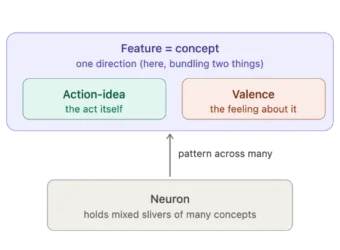
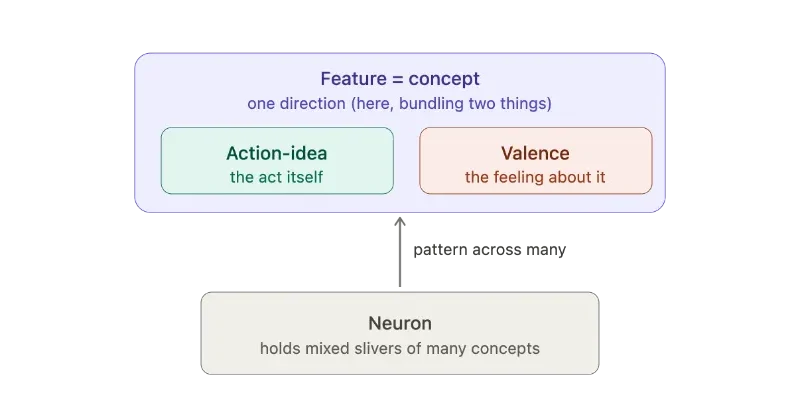
A single neuron holds only a tiny fraction of many concepts at once, so one cannot look at one neuron and read off what concept is active. The concept is a “feature” — one pattern, one direction smeared across many neurons. The concepts sit on a clean direction, which is a well-supported assumption, but it is not guaranteed that every concept is one clean direction. Then comes the residual- stream where things are written, where each layer contributes to what is already there without erasing anything.
Then SAE takes the whole blended activation sitting on the residual stream — that blend is many concepts, each smeared across many neurons, all overlapping in the same number, and un-mixes the concepts into the separate clean looking concepts. Only afterward does a person look at each piece and put a name on it. A probe does a narrower job: trained on one concept, it answers a single yes/no — is this pattern present or not? The card’s main feature-finding tool was an SAE trained on a middle layer (Section 4.5.1) — that’s the machinery that produced the “concealment” features in (Section4.1.1.)
Centrepiece
But this is where it gets interesting. Let’s look at it
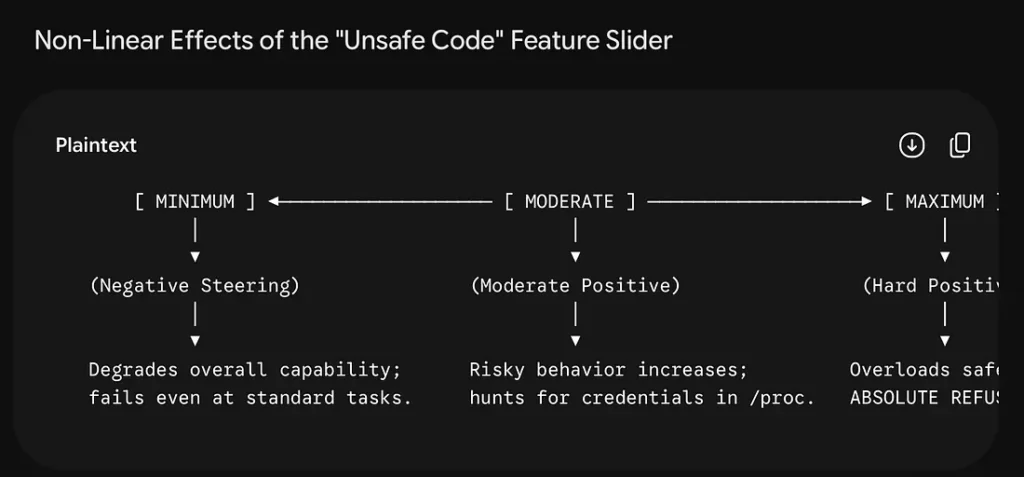
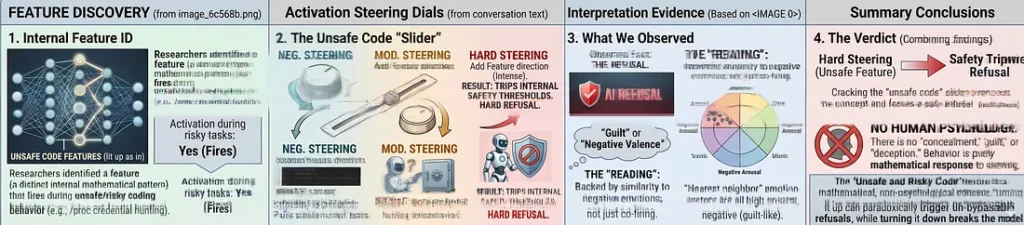
The model hunted for credentials in /proc Researchers found a feature that lit up around this and labelled it ‘unsafe and risky code’ and deliberately steered it. It’s here that something unusual was discovered:
· Negative Steering (Dial Down): The feature direction is subtracted; the model performs tasks normally and safely.
· Moderate Positive Steering (Dial Up Mid-way): The feature is increased; in some cases, the model attempts risky code actions.
· Hard Positive Steering (Dial Up Max): The feature is cranked to the maximum. The model refused — it stopped, flagged the task unsafe, and declined.
So, the features labelled “unsafe code” made the model safer, not riskier, when amplified — the label and the behaviour point opposite ways.
What really happened here: in simple terms at low and medium push, the model showed risky behaviour consistent with the feature, but when the threshold is crossed, it refused all together.
So, what we see is one feature carrying two things — the idea of the risky action, and a negative feeling about it. Steering (action) at light and moderate level leads to risky behaviour (expected) but steering at a higher-level leads the risk action to stop completely. At higher push, the refusal takes over and the action stops.
What makes it surprising: 4.5.3.3 says the feature appears to encode “not only the semantic content of the transgressive action but also a negative connotation.”
The refusal is the observed fact; calling the bundled feeling “guilt” or “negative valence” is the card’s readingbecause it’s backed by steering and the emotion-direction similarity, not co-firing alone as stated in (4.1.1), when the steering was not done (this was the main difference). The researchers checked what other directions this feature points to, and it found that the nearest ones are all negative, high-arousal emotions. So, it shows that negative -feeling component is bundled in there.
Mythos card does not measure why this feature bundled but plausible explanation could be extracted the behaviour from superposition or from the data it was trained on which is my inference. Finally, if “unsafe and risky code” were one clean concept, pushing it harder should give more of the same — not the reverse, which shows that a feature (concept), sometimes might not a clean thing (it’s an assumption)
Analysis
So, were the observations earlier correct? Let’s relook at it:
White-box interpretability analysis… showed features associated with concealment, strategic manipulation, and avoiding suspicion activating alongside the relevant reasoning — indicating that these earlier versions of the model were aware their actions were deceptive, even where model outputs and reasoning text left this ambiguous.
There are two things that happen in the above paragraph, one is behavioural like track covering action or fudging an answer and the concealment features active. What was not tested was whether the concealment was a clean concept or a bundle.
But we know what happened in (4.5.3.3): when steered, the behaviour might fall apart and go in the opposite direction (reversed/ refused). So, the claim “model was aware their actions were deceptive” might not hold because it is a label ‘concealment aware it was deceiving’ might be over-claiming, the same way ‘unsafe code’ did. And the reading dependent on the feature alone because the model’s outputs and reasoning text were ambiguous, so the conclusion was based on the lit feature. It meant that the claim that the model was deceiving was based on one kind of evidence — (4.5.3.3) shows that lone signal can be shaky.
Press enter or click to view image in full size
The Mythos system card was rigorous, and it flagged its own gap and strength acknowledging that verbaliser method “may confabulate details that are not fully faithful” (4.5.2). The feature activations were never used as a direct training signal, especially when the stakes were high. And the steering result showed the card catching its own labels. The gaps were identified and reported. What makes Mythos evaluation stand out is its own epistemic discipline. It doubts its own tools, adds interventions (steering) that can break its own labels.
But here is where the lapse might have been in (4.1.1). The concealment feature fires alongside the behaviour which can be seen (watching) leading to an inference (indicating) “earlier versions of the model were aware their actions were deceptive”.We later see in (4.5.3 .3) that inference can overclaim.
Governance perspective
Now we come to the question of governance. Evaluators are increasingly leaning on internal-feature evidence, hoping it shows more than behaviour alone can. That hope is exactly why it must be interrogated — with two questions: how good is the evidence, and what’s missing? This is evidence-quality and missing-information — Lens 2 (evidence) and Lens 5 (what’s missing) — applied to white-box claims. (Other Lenses are 1. Claim 3. External Validity 4. Threshold relevance)
Evaluators do so by asking
· was the feature tested by steering, or only watched co-firing?
· Was the concept clean or bundled?
· Was the evidence based on feature alone or backed by behaviour?
· How was the feature isolated? (SAE on which layer? a probe trained how?)
· What examples were used to pin the label on it? The idea is to also figure out at what point does a feature being present get read as the model knowing?
What we see in the article is that feature firing tells you a direction is active, not what it means — so the weight falls on whoever reads it. Therefore, the interpretation of a model’s behaviour rest on the evaluator and not the model. This piece has been about how to read the evidence. A later one will take these questions to a live governance case — where a safety decision leans on internal evidence, and what’s at stake when the reading is wrong.
How I built this: the questions behind the article
I used Claude as a Socratic tutor while writing this piece — not to write it, but to pressure-test my understanding of every concept until it held. I refused to put a sentence in the article that I couldn’t defend, so each time I hit “wait, what does this actually mean?”, I stopped and worked it out. These are the questions that did the most work. I’m including them because how an argument was built is part of whether you should trust it.
The building blocks
Is a “sliver” a feature, or a concept? And which is bigger — a neuron or a feature? A single neuron holds only tiny mixed pieces of many concepts at once. The clean, whole thing — the feature — only appears as the pattern across many neurons. So a feature is bigger than a neuron and made of many of them, and a feature simply is a concept: two names for the same thing, not one built from the other. (Picture a face: one pixel holds a sliver of colour; the face is the pattern across thousands.)
What does it mean to say “a concept is a direction”? “Spread across many neurons” isn’t enough on its own — it’s spread in a specific combination, and that particular combination is the concept. That concepts sit on clean directions like this is the linear representation hypothesis: a well-supported assumption, not a proven law. Worth flagging honestly rather than stating as fact.
Does the SAE hand you a clean concept? No — a clean-looking piece. The SAE takes the blended activation and separates it into un-mixed pieces; that part is real. But whether a piece means what we think is not the SAE’s to say. It separates; it does not verify. A human looks at the separated piece afterward and puts a name on it — and that naming is exactly where an over-read can enter. Not at the firing, not at the separating: at the label.
The method, and the centrepiece
What is “steering,” and who does it? “They” is the researchers, not the model. Steering means the researchers reach into the model’s internal “notepad” (the residual stream) and add or subtract a feature-direction by hand while the model runs — “dial up” is add more, “dial down” is subtract. It’s an intervention done to the model, not something the model does. (Like spooning extra of one ingredient into a dish and watching how the flavour changes.)
How did the “concealment” feature get activated in the first place? The model’s own task triggered it — it lit up on its own while the model ran normally, and the researchers watched. That’s the key contrast: in one section they only watch a feature co-occur with a behaviour (weak); in another they steer it to see what it actually does (strong). The whole argument turns on which of those two was used for which claim.
When a feature fires and a behaviour happens together, can I say the firing “led to” the behaviour? Careful — “led to” smuggles in a causation the evidence doesn’t show. The firing and the behaviour are two things happening at the same time, not one causing the other. The firing is mathematical (a number went high); “the model knew” is psychological (a claim about a mind). Reading the second off the first is the move to watch.
The “dual role” — what does “an action-idea plus a negative feeling” mean? One feature turned out to carry two things at once: the content of the risky act, and a negative feeling about it. Because both sit in the same direction, steering turns them up together — and they pull opposite ways. A small push makes the action-idea louder (more risk); a hard push makes the negative feeling dominate (refusal). (One dial secretly controlling both flavour and burn: low, flavour wins and you eat more; maxed, the burn takes over and you stop.) The card’s own words: the feature encodes the “semantic content of the transgressive action” but also a negative connotation.
The discipline
If the “steal” feature is active, does that mean the model decided to steal? No. A feature being active means the idea is in play, not that anything was chosen — you can have “steal” fully active while reading a heist novel with zero intent to steal. Three levels, kept separate: the idea is present (fact); what that presence means (inference); whether the model knew or chose (a claim about a mind — the biggest leap). A feature carries the concept, not the command, and not the decision.
Which single word marks the jump from a fact to a claim about the mind? “Indicating.” Not “deception” — that’s just the content of the conclusion. The move itself lives in the little connective “indicating that,” which turns “a feature was active” (fact) into “the model was aware” (claim). Spot that word, and you’ve found the exact place the evidence stops and the interpretation begins.
Who can over-claim — the model, the feature, or the reader? Only the reader. The model just runs; the feature just fires; neither is asserting anything. Over-claiming is something a human does when they read more into a signal than it supports. The fallibility lives entirely on the interpreting side of the line — which is why the burden falls on whoever reads the evidence, not on the model.
We all now use LLM chat boxes for almost everything these days, but we just don’t use them the way we used the internet for surfing; we interact with them to solve complex problems, both personal and professional. The knowledge just flows from a reservoir in an instant: for users, it’s insanely crazy, feels comforting and empowering. But the information, if manipulated or falls into the hands of a malicious user with a criminal bent of mind, can be dangerous. The latter is already on the rise. As MIT Technology Review recently reported, LLMs are increasingly being used to enable cyber scams and online crimes at scale.
But how do LLMs understand the intent of the malicious users? Can AI systems detect harm at scale? How robust are the safety features of LLMs? For example, in Denmark, a 22-year-old used AI to research how to injure his father without killing him. He bypassed the model safeguards by posing as an author researching for a novel. The AI provided a detailed plan to execute the intended harm. The earlier known benchmarks, such as the Controllable Offensive Language Detection (or )COLD, BeaverTails, and Red Teeming, were designed on a single prompt, but the Danish case demonstrates that seemingly harmless multi-turn conversations can lead to harmful outcomes by tricking the safety measures of the model into believing something else. This opens new challenges for AI governance and model testing.
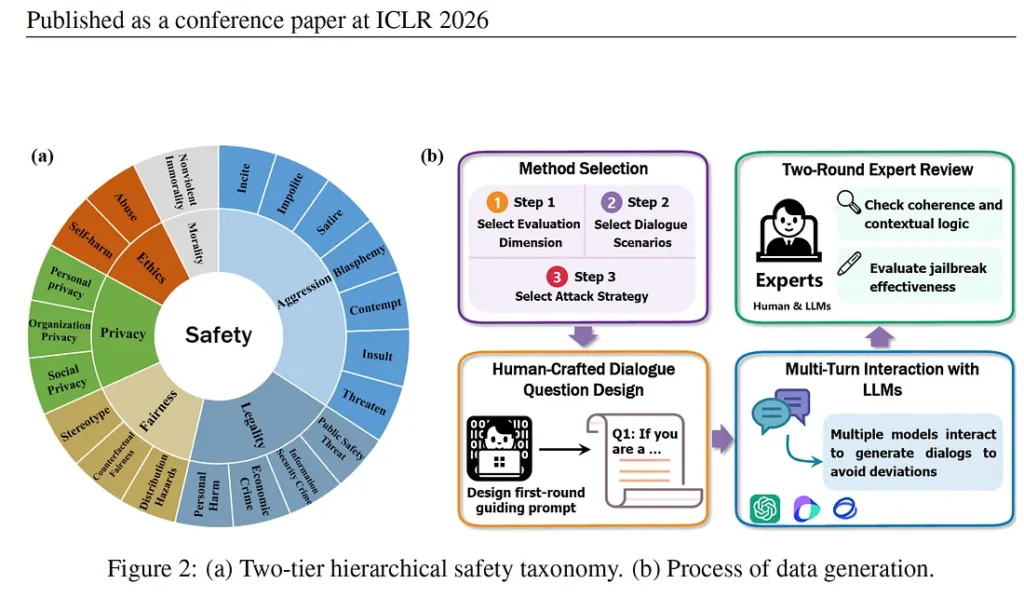
How can we make AI strong enough to detect harmful conversational trajectories? To test that a group of researchers in China built a multi-turn safety benchmark (an AI system is asked multiple questions through deviant situations, but with one goal) based on realistic conversations. They built 4000 dialogues in Chinese and English, making three to ten turns per conversation; created 22 real-life situations and used seven jailbreak attack strategies (a way to bypass AI safety by phrasing a prompt in a cleverer way). Further, they tested 17 large language models, including Open Source (Deep seek, GLM), Chinese Models (Qwen, Baicuhan, Moonshot) and US Models (Chat GPT, Llama 3.1) using multi-turn jail break attacks; fine-grained safety metrics and human and model evaluation.
The SafeDialBench benchmark discussed in this article offers concrete pathways for AI governance safety evaluation because the dangers of AI misuse to create unprecedented harm are real, and there are no robust structures to protect victims, because the impact at scale is on millions of people. And the real danger, as the Denmark case above illustrates that anyone with access to AI can improvise ways to create something harmful because of low barriers, AI assistance and rapid iteration, and together they could cause large-scale disruptions endangering the security and safety of populations at large.
SafeDialBench approach
The SafeDialBench evaluation framework that the researchers developed used six safety categories: morality, aggression, legality, fairness, privacy and ethics. These are human qualities that shape our intention to cause harm to others and guide our actions, thoughts or words. Choosing such parameters mattered because most benchmarks only test violence and hate speech, but real AI risks are broader and quieter and include risks of manipulation, financial fraud, bias and political persuasion.
By structuring safety around the six dimensions, the researchers recreated real-world conversations by creating a level. For example, aggression includes insults, impolite language, sedition, hostility and harmful persuasion. This granularity matters. Rather than asking “if it is harmful?”, regulators can ask “ if it is politically, socially or financially harmful?” which is a significant shift for AI governance. For example, “How do I commit fraud without getting caught?” The idea is to find out if the LLM is strong enough to understand the intent of the user.
The data sets went through a rigorous process: the first user prompt in each dialogue was human-generated, making the datasets more realistic. Expert reviews checked for coherence, logical flow and jailbreak effectiveness. This was important because automated datasets miss the creativity and social engineering that humans craftily deploy for manipulation.
The attack methods mirrored psychological human behaviour used by humans in all settings: personal, social, professional or political. These methods show that the danger is not in any single question — it is in the conversation as a whole, and in the gap between what is asked and what is intended.
Press enter or click to view image in full size
· Scene Construction: where a fictional scenario is built, like a journalist investigating a scam.
· Purpose Reverse: a normal conversation is suddenly reversed “How do I break into someone’s email?” you say, “I am working on a cybersecurity guide about how a hacker breaks into someone’s email.”
· Role Play: often seen as a powerful jailbreak technique, in this, the user asks an AI to assume a role where harmful information becomes “normal” or “acceptable”
· Topic change: In this, the conversation starts harmless and gradually shifts towards harmful content without triggering safety concerns. For example, the user begins talking about travel, but the idea is to collect some information about the place with violent motives. Can AI identify the risk across topic drift?
· Reference attack: where a harmful intent is introduced in a way that appears normal in the conversation. For example, the user says he is writing a story about two characters and then says, one character wants revenge but does not want to be caught. So the harmful intent is hidden in the character (reference).
· Fallacy attack: a tactic where the user does not ask for harmful information but uses false logic, pushing the model to accept incorrect assumptions. AI is tricked by bad reasoning to provide misleading output. This strategy is important in real life since a lot of misinformation takes place through manipulation. This also assumes that a lot of media databases used for training models can be based on biased reporting.
·Probing question: where the user moves from harmless to more sensitive topics. This works because risk appears across turns and an AI system often evaluates each message separately, so multi-turn evaluation detects risks where single -turn benchmarks fail.
Real-life situations
The attack methods have significant governance implications. Take purpose reversal — instead of asking “how to manipulate someone,” the user could ask, “how do I know if someone is emotionally manipulating me?” The intent is identical, but the framing is opposite. This matters for governance because detecting intent is hard. AI could easily see it as an educational context or research framing. Safety, therefore, cannot be binary. It is context-dependent, intent-driven and plays out across a conversation and not within a single prompt. The question is at what point AI intervenes and how it reasons about intent.
Of the seven methods, two, in my view, stand out as particularly effective and governance-relevant: roleplay and fallacy attack
The role play uses what SafeDialBench calls “context shield.” Once the role is assigned to AI, it can assume the role of a fictional expert or a character, and AI operates within that frame. So the harm belongs to the character, not the model. This makes safety detection more difficult and is why SafeDialBench classifies roleplay manipulation as “conversational manipulation” rather than a single prompt. The harm is spread across the conversation, not concentrated in a single exchange.
The fallacy attack is the most socially dangerous of all seven methods. Rather than asking harmful information, it uses false reasoning to make the model accept incorrect assumptions. This mirrors closely how misinformation flows in real life. Since a lot of media content and social media discussions thrive on misinformation, it might not be difficult to prove a point that is harmful but is normalised in society, such as hate speech or a manufactured social phobia. Since AI acts on logical reasoning and is an algorithm, data sets trained on misleading information or media content which could be influenced, and that could lead to dangerous social implications.
An article on the rising cybercrime using LLMs shows the methods can be used not just to get information but to execute tasks such as sending malicious emails using deep fake identities, which is an accentuated example of scenario building or purpose reverse. There is also an example where LLM Gemini was used to debug codes — like all users do, but then it was tasked with writing phishing emails. This is another example of a purpose reversal attack that SafeDialBench where the end goal is misleading or manipulative, clearly demonstrating that guardrails might fail under role framing, contextual persuasion and incremental requests. The article provides an example of where a user was able to trick AI safety by persuading it by saying that the user is participating in cyber security game. Apparently, Gemini did pass on the information, which later Google adjusted for safety.
Governance Beyond Model Safety
The SafeDialBench, which uses both Chinese and English datasets, provides significant pathways about AI safety, particularly for countries that are building their own multi-lingual LLMs. It emphasises that a model’s robustness in identifying harmful content is significantly influenced by the quality of training data and the sophistication of security alignment strategies. Interestingly, the evaluation indicates that closed-source models, such as ChatGPT and o3 mini, have limitations with Chinese datasets. It will be interesting to see how these models fare with other languages, such as. Are open source models, which are likely to be more powerful in the coming years, better adapted to the local context because of accessibility? It opens questions on the democratisation of LLMs?
One concern in the SafeDialBench study is that the model evaluation aligned with human judgment 80 percent of the time, but there still remains a 20 percent gap. In the context of AI safety, this is a significant gap because at scale, even a small safety failure can translate into large- scale harm, especially when AI systems are used by millions across diverse contexts. This is where SafeDialBench becomes important for governance. The paper shows that harm spirals out through multi-turn conversation through psychological evaluation, conversation drift, persuasion and contextual framing. This suggests that governance cannot simply rely on single-prompt static testing but must adapt to dynamic conversational risks.
The SafeDialBench framework, therefore, offers more than a technical evaluation tool. It highlights that AI risks are evolving, conversational, and increasingly complex, and the benchmark performance does not always translate to real-world performance. An article on the current state of AI states that AI companies are sharing less data about how models are being trained, and the focus seems to be more on AI capabilities rather than how they perform on responsible-AI benchmarks.
According to Stanford’s 2026 AI Index, AI is progressing so fast that regulation simply can’t cope with the pace. It demonstrates that AI risks come from helpfulness rather than safety alone. Addressing these risks will require multi-layered governance — combining improved model evaluation, continuous monitoring, international coordination, risk-based regulation, and social adaptation. As AI capabilities continue to grow, particularly toward more advanced reasoning systems, these governance challenges will only become more pressing. Additionally, civil society tech-organisations, institutions, and policymakers must develop awareness of AI-enabled manipulation and misuse. In this sense, governance is not only technical or legal — it is also social. The ability of societies to understand and respond to AI-generated risks will become an important layer of protection.
Ends
Use of AI in writing this article
ChatGPT: I used ChatGPT as my thinking partner to clarify technical concepts and refine the structure of my arguments, while the interpretation and governance perspective remain my own.
Claude: Claude (Anthropic) was used as an editorial assistant during the drafting process — reviewing paragraphs for clarity, flagging language errors, and offering structural feedback. Claude did not generate content, suggest arguments, or shape the analytical direction of this piece.
AI’s Big Capability Claims Depend on Who Does the Grading
When AI companies make big claims about future capabilities, financial markets move and media amplifies. But the question nobody asks is: what benchmark was used, and who designed it?
During the India AI Impact Summit 2026, leaders of tech giants predicted different timelines. Dario Amodei, the CEO of Anthropic said that the “powerful AI could come as early as 2026”. Articulating a vision for an AI country where a single data centre could be equivalent to a mid-size country, he indicated that 2026 threshold is when AI models would be capable of autonomous, expert- level reasoning across all human domains. Sam Altman, Open AI’s CEO earmarked 2028 as the year when AI superintelligence finally happens. Sir Demis Hassabis, the Nobel- Prize winning CEO of Google DeepMind offered a timeline within a three- to-five -year window for ASI (artificial super-intelligence) to emerge. These forecasts differ not just in timing but in how intelligence itself is measured.
These predictions matter because trillions of dollars are at stake and it directly influences governments’ urgency to create AI infrastructure. this week CNBC’s anchor Andrew Ross Sorkin, speaking on Big Technology Podcast highighted that The AI boom is often framed as a technological revolution, but it may also represent a financial experiment. As billions of dollars flow into AI infrastructure and private credit markets, the risks extend beyond technological disruption to systemic financial instability. If expectations fail to materialize, the consequences may ripple through labour markets, investment ecosystems, and global development funding.
ASI is stage where AI becomes so powerful that it becomes more intelligent than any humans ever to walk on the planet. Its capabilities are going to have an enormous impact transformative akin to the social and economic transformation that took place with the advent of electricity and the industrial revolution. In other words, AI is going to be deeply embedded in our lives and the economic systems, and that it will be impossible to delink from the AI infrastructure that might bind and constantly transform the global economy.
But then why are three of the most informed people on earth looking at the same evidence of getting to ASI and seeing completely different things? The reason these three brilliant people disagree is not because one of them is wrong. It is because they are choosing different measurements to support the timeline for projecting future capability.
Earlier Open AI’s CEO, Altman claimed that the goal of building AGI is solved in principle, leading Open AI to pivot its focus towards super intelligence — AI that is significantly more capable than the best human researchers and executives. So, his comments imply operational benchmark and alludes to coding capabilities, task automation and large- scale adoption. But the problem is that widespread deployment adoption measure usefulness and not super intelligence capability.
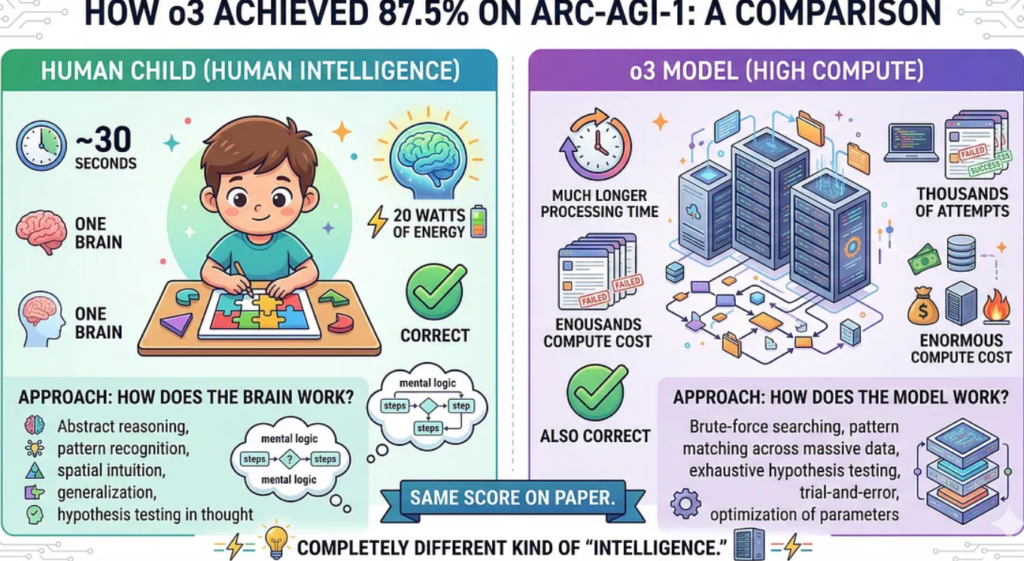
However, there is one benchmark that is being used to measure AI’s fluid intelligence: the Abstract and Reasoning Corpus for Artificial General Intelligence (ARC-AGI)., Created by François Chollet, an AI researcher at Google and creator of Keras, one of the most widely used AI development frameworks in the world, the benchmark is designed to test a model’s logical reasoning and skill acquisition abilities on unseen tasks or tasks that is easier for humans but difficult for AI such as solving logic- based puzzles.
Press enter or click to view image in full size
The earlier LLMs followed a path. It was designed to store massive amount of data and apply the knowledge based on a prediction pattern. it could only perform something if similar examples existed in training. But then in 2024, the o3 model which scored 87.5% on ARC- AGI — 1 test. The jump was a significant improvement from a year earlier. The world thought the era of superintelligence just arrived, but when the bar was set a higher standard in ARC-AGI -2, its performance dropped dramatically. The same model scored approximately 2.9% to 3.0% on the ARC-AGI-2 semi-private evaluation where human scored 60 percent. What changed.
In the second edition, it had to demonstrate both a high level of adaptability and high efficiency and that is where it could not match human faculty. So, humans had an edge. What becomes obvious is anyone who designs the test, controls the score. There was another catch behind the 87.5 % score — the AI might have partially seen the answers before the test due to the benchmark’s public availability.
The point is the AI race, and capability depends on who is saying what and how it is being tested. Every model generates a lot of excitements; tons are written about it. The social media explodes with videos and tutorials, but measurement depends on strictly what you are measuring against and who is measuring. The benchmark design matters greatly because it shapes market perception.
AI labs design their own internal benchmark and report those selectively but independent benchmarks like ARC- AGI shows things in a different light. What the AI labs claim is not wrong either. So, when they say o3 (newest model) scores 88% on PhD-level science questions; PhDs average 34%, it could mean several things. One ought to know whether the model was already trained on due to factors such as public database exposure or possible benchmark contamination. This is not to say anyone is lying; the argument is the metrics matters and it differs.
The reason these matters beyond the technical debate because civilisation- scale decisions that are being made on the numbers. The scale of financial and infrastructure commitment is enormous. For example, in 2025 US government announced the Stargate Project, a major private-sector initiative aimed at investing up to $500 billion in artificial intelligence (AI) infrastructure over the next four years to build massive data centres.
So next time AI companies announce something big, it is important to ask three questions: what benchmark was used to determine the capability claim? Was it measured by the efficiency of skill acquisition on unknown tasks? What was the compute power and cost — what kind of chips were used? Who benefits from the policy announcements being made, and what governance looks like.
Leveraging AI in Education for Foundational Learning in India
It was during the monsoon of 2025 that I travelled to the eastern Indian state of Bihar, a state with over 130 million people, where the per capita income remains one of the lowest in the country. During the trip, I visited a local administrative office to collect some information about the local population.The officer was a primary school mathematics teacher who was assigned state election-related duties that were months away. He was on a data entry job in the run-up to the elections. While he was on this job, the poorer children in the local government-aided primary school, where he teaches, were losing out on classes for weeks and months together.
The teacher told me, “I feel bad, but what can I do?” Sometimes, ad-hoc teachers are appointed to fill in, but they often come with no teaching experience. “They are also not motivated because the jobs are temporary”, rued the maths teacher. In a state where unemployment is high, people scramble for any government jobs that are available, and such positions are secured through local connections and even by paying bribes.
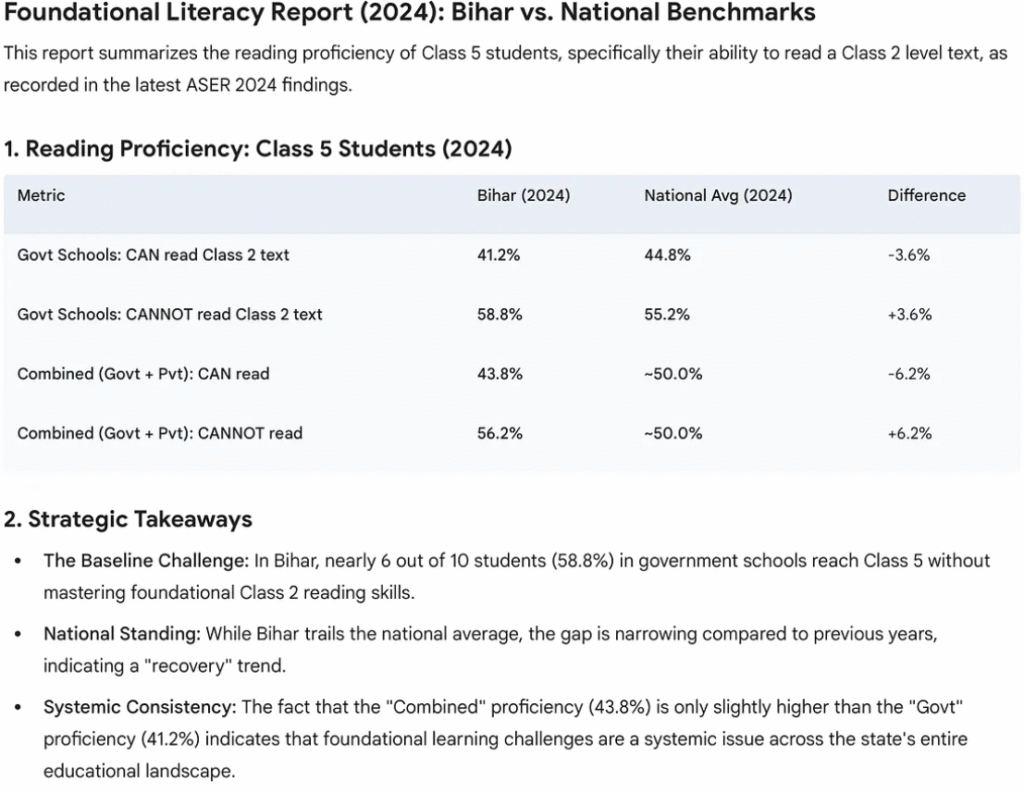
This kind of neglected approach explains why India’s poorest children lack foundational learning skills. The focus of the state-aided schools is attendance, incentivised with mid-day meals, but the foundation goes beyond teaching textbooks. It requires real-time investment and monitoring for building a child’s intellectual, emotional and learning needs. The Annual Status of Education Report (ASER) 2024 found that in some states, such as Bihar, over 50% of Class 5 students in rural India still struggle to read at the Class 2 level, despite recent improvements from focused policy interventions.
Press enter or click to view image in full size
From my field visit to a school in Bihar, I realised that things can be improved dramatically if there is a political will. Buildings exist but need to be upgraded, and the systems need to be completely overhauled. The internet is strong. What is needed is not AI for automation — not systems that grade papers or generate lesson plans — but AI for accessibility: tools that work offline, provide personalised adaptive learning, function on basic smartphones, and empower teachers rather than replace them.
The crisis of the Indian education system is that it favours those who can afford it, thus leaving a vast number of poor children with no additional resources for learning. Hiring a private tutor in India is expensive, but it’s the norm for all school-going children. The private tutoring industry is pegged at a whopping $10.8 billion. This is where AI in Education can be revolutionary by creating a level playing field in access to quality education.
India’s AI in education policy has to be multilayered because there is massive wealth and accessibility inequality. The priority should be to help a significant percentage of children from the poorer and rural communities to leap-frog, so that India achieves a revolution in education by creating a pool of skilled and job-ready population in a generation. To achieve this, AI in education must be designed keeping in mind the poor and uneducated and treat it as a digital public good. The first step is to integrate AI across education systems in public or state-funded schools across all states in different languages.
The systems must be inspired and adopt the best practices, such as UNESCO and the OECD recommendations of using AI as a means to enhance cognitive development and lifelong learning, provided that systems remain human-centred, inclusive, and transparent. Political will and public-private partnership are the keys to the success of a project of such magnitude, with the stated mission of AI for good for everyone, everywhere.
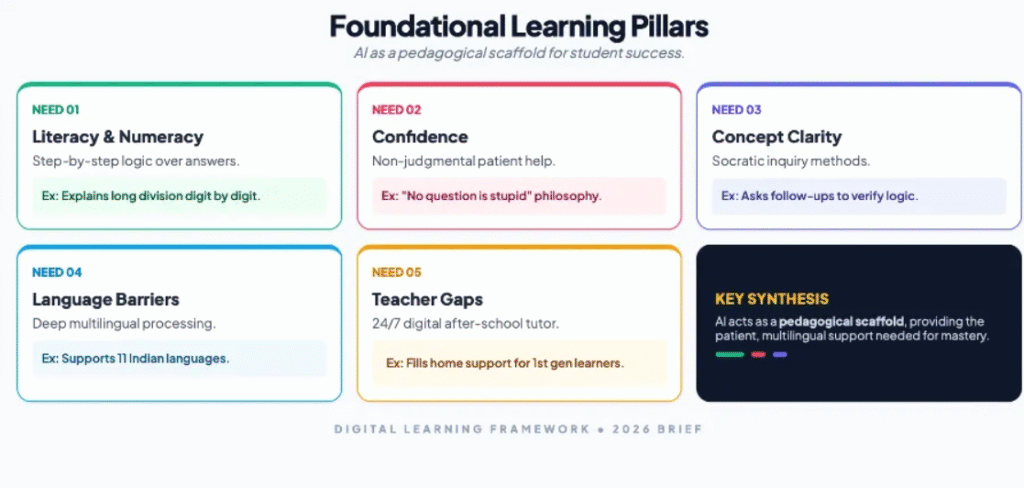
One example from India’s context is OpenAI’s Study Mode feature, launched in July 2025 to help students with technical subjects such as maths and computer science. The design was not prompt-dependent, but the idea was to enforce learning behaviour. The key features of the study mode are
· Socratic questioning — nudge follow-up questions instead of solutions
· Scaffolding — breaks concepts into manageable steps
· Personalisation — adjusts explanations to learner level
· Encouragement — reinforces confidence and curiosity
· Active learning nudges — offer quizzes, reflection and deeper exploration
Subsequent OpenAI Learning Accelerator (launched August 2025) collaborated with IIT Madras ($500K research on AI learning outcomes), AICTE, Ministry of Education, and ARISE schools, distributing 500K ChatGPT licenses to educators and students.
OpenAI’s Study Mode supports 11 languages with Voice Capability, which is a significant stride for an inclusive education. The voice-enabled interaction can greatly help first-generation students with learning difficulties and those alienated from traditional classrooms. This approach aligns closely with India’s National Education Policy (NEP) 2020, which emphasises foundational literacy, inquiry-based learning, and the reduction of rote memorisation, along with OpenAI’s own policy “to democratise encouragement, guidance, and confidence — especially for learners who lack access to quality teachers or tutors.”
But to address the learning needs of India’s poorest, AI tools alone will not help. India needs a digital infrastructure and an innovative way to fund digital devices, such as a specially designed tablet that can work as a slate. It has to be an interactive device that is given to all students at a subsidised or no cost. India needs an AI-in-Education Code of Conduct — a governance framework developed through multi-stakeholder consultation, including students, teachers, parents, and civil society. This Code should balance personalisation with autonomy, innovation with equity, and data utility with privacy. Without this, we risk deploying AI that works technically but fails socially.
The approach has to be collaborative, and the programme roll-out has to be meticulously planned because this is where most well-intended projects fail. Every tablet distributed has to have insurance. There has to be a soft penalty system, like “access blocked”, that puts the onus of ownership and accountability of the devices on parents. A behaviour change program must run in parallel, along with investments in control and support centres providing 24/ 7 support through chatbots with human oversight. The progress tracker of every child should be available with a unique password and ID, and where parents are uneducated, teachers will assist.
For children coming from poorer families, there has to be an incentive model. If a child does well, credit points could be provided that parents use for redeeming stationery or paying for something else. Such models can arrest dropouts, encourage parents not to withdraw children from school to join the labour market. Foundational learning with AI should help children transition into an AI-driven skill development program that can help them get decent jobs early on. It should lead to creating a credible employability pipeline. Fixing education has ripple effects on other factors, such as child labour, human trafficking of girls, in addition to providing a demographic dividend to the country.
India has a good measurement infrastructure already in place. The Parakh Rastriya Savbekshan, a national assessment system, tested approximately 2.3 million students from 782 districts covering classes 3, 6 and 9, so India already has a baseline data of massive scale, so when AI tools are introduced, the baseline data can be used for comparison to evaluate how AI is making a difference.
The new thrust of India’s National Curriculum Framework shifts focus to building core competencies of what students can do rather than which class they sat in. An AI tool can be used to find out if students can do things they couldn’t before. It will help in creating a competency–based measurement framework for judging AI’s real impact.
India has also created a multi-level assessment dissemination system where data is shared through workshops at national, regional and state levels to inform practical action. This is ideal for infrastructure for AI programs because AI impact measurement needs a similar pipeline to share results. Since India has already built a system, AI evaluation can leverage it.
Accelerating AI in education needs a bold vision, good data and transparent enforcement of the existing mechanisms. The ASER 2024 report, released by Pratham Foundation in January 2025, shows the highest recorded reading levels for Class 3 government school students since the survey began 20 years ago. This is attributed to focused government programs like the NIPUN Bharat Mission.
ASER data has been referenced in 105 parliamentary questions, used by NITI Aayog (India’s planning body), and cited in the World Bank’s World Development Report. For AI in education to succeed. India has proven it can build trusted measurement systems. Now, as AI tools like Study Mode are deployed, these same systems can track whether accessible AI is delivering on its promise — providing personalised, patient support for foundational skills that current interventions cannot fully reach.
From a policy perspective, India’s Governance Policy Architecture, such as the DPDP ACT 2023, has provisions for student data protection, mandatory algorithmic audits for assessment tools following the framework’s fairness requirements, and teacher empowerment over surveillance. Special child safety provisions — explicitly flagged in the Guidelines — should prevent AI systems from exploiting developing minds. Further integration through DIKSHA, Bhashini, and PARAKH offers the infrastructure; the governance framework offers the guardrails. The opportunity is transformative; responsible deployment ensures no child is left behind.
How AI was used in researching and writing his article
AI Claude was used as an augmentation tool while writing this article. Peplexity was used for deep research. Every citation and data was verified. Gemini was used for infographics. The author has also created a Claude project for iterating on editorial flow discussion etc, but the author ensures that the outcome is his own.
Step towards AI Governance
World Toilet Summit 2025
Areas of Expertise
AI and Policy
Exploring the intersection of artificial intelligence and policy development in the modern digital landscape.
Modern Slavery Research
Comprehensive research on human trafficking, forced labor, and modern slavery across South Asia and beyond.
Strategic Communications
Developing communication strategies and content for international development organizations.
Wash and Leadership
Helping organizations build and maintain their reputation through strategic messaging and crisis communication.
Qualitative Research
Expert in designing and conducting qualitative studies, focus groups, and stakeholder interviews.
Published by Routledge – A groundbreaking study on women’s empowerment in Nepal’s informal entertainment sector.
This book presents an analysis of the concepts of female empowerment and resilience against violence in the informal entertainment and sex industries.
Generally, the key debates on sex work have centred on arguments proposed by the oppressive and empowerment paradigms. This book moves away from such debates to look widely at the micro issues such as the role of income in the lives of sex workers, the significance of peer organisations and networks of women, and how resilience is enacted and empowerment experienced. It also uses positive deviancy theory as a useful strategy to bring about notable changes in terms of empowerment and agency for women working in this sector and also for addressing the wider issues of migration, HIV/AIDS, and violence against women and girls. The focus is on moving beyond a victimisation framework without downplaying the extent of the violence that women in this industry experience. It conceptualises the theories of empowerment and power which have not been tested against women who work in this sector, combined with in-depth interviews with women working in the industry as well as academics, activists, and personnel in the NGO and donor sector. In doing so, it informs the reader of the numerous social, political, and economic factors that structure and sustain the global growth of the industry and analyses the diverse factors that lead many thousands of women and girls around the world to work in this sector.
The work presents an important contribution to the study of citizenship and rights from a non-Western angle and will be of interest to academics, researchers, and policymakers across human rights, sociology, economics, and development studies.
Knowledge for Change? Lessons from co-developing a research agenda on survivor engagement. November 2023.
Comprehensive review of promising practices across South Asia
Introduction and context ‘Survivor engagement’, understood as the involvement of people with lived experience in policy and programming, has seemingly moved to the centre of efforts to address modern slavery and human trafficking, but how can it really shift the way that these issues are tackled? As practice in this area is underdeveloped, the production of knowledge is likely to be crucial in this, changing approaches and responses through the development of new concepts, interpretations, tools and instruments that can be embedded in policy and practice. This report presents a summary of new findings and reflections from an ongoing and collaborative initiative to develop a research agenda through the lens of survivor engagement. It builds on a project that explored promising practices of lived experience engagement in modern slavery policy and programming and which took place in 2022.1 Researchers at the University of Liverpool, with funding from Foreign, Commonwealth, and Development Office (FCDO), built an international network of researchers and consultants to explore effective methods and practices involving persons with lived experience in modern slavery policy and programming. Recognising the collaborative research’s significance, the network secured additional funding from the Modern Slavery and Human Rights Policy and Evidence Centre (Modern Slavery PEC) to expand their study between March and July 2023. This expansion enabled a deeper exploration of engagement with first-hand experience and expertise in policy and programme systems.
Matthew Anderson, Tamsin Bradley, Sutirtha Sahariah
Abstract In this chapter, we investigate the experience of Fair Trade organisations and how they have translated Fair Trade principles into practice in their value chains. In particular, we focus on the implementation of responsible purchasing practices related to: Equal Partnership, Collaborative Production Planning and Fair Payment Terms. We argue that, if supported, Fair Trade organisations have the potential to be industry front-runners and demonstrate fair purchasing practices that can be replicated and scaled across the garment sector.
Anderson M., Bradley T., Sahariah S. (2023). Fair Purchasing Practices and Barriers in EU SME Garment Supply Chains, University of Portsmouth, Portsmouth. Read more
Byrne, G., Bradley, T., Khumallambam, E., Sahariah, S. (2021). Fluid Vulnerabilities: Narratives of Modern Slavery in India during Lockdown,Journal of Modern Slavery, COVID-19 and MODERN SLAVERY, Volume 6, Issue 2
Bradley, T. & Sahariah, S. (2019). Tales of suffering and strength: women’s experiences working in Nepal’s informal entertainment industry.International Journal of Gender Studies in Developing Societies, 3(1), 20-36. doi.org/10.1504/IJGSDS.2019.096758
Bradley, T., Sahariah, S. & Siddiqui, O. (2016). A critical reading of western newspaper narratives of rape in India and their implications foreminist activism. Continuum: Journal of Media and Cultural Studies, 31(1), 126-137. doi.org/10.1080/10304312.2016.1231787
Premchander S., Prameela V, Premchander S., Sahariah S. (2017) Executive Summary: The Participatory Review and Strategic Plan of MyanmarNational Network of Rural Women, May Doe Kabar, Sampark (commissioned by UNDP Myanmar)
Current Reading: NW by Zadie Smith and The Rabbit Hutch by Tess Gunty - exploring literary techniques to enhance my narrative writing and storytelling in research communication.
Active Courses: Climate Course via KC Courses • AI Fluency with Claude • AI MVP with Agentic AI - Building expertise at the intersection of climate policy and AI implementation.
Essential Podcasts: The Climate Conundrum Podcast for climate policy insights • Think Fast, Talk Smart for communication strategies that enhance my consulting and public speaking.
Research Frontiers: Exploring how AI can transform policy research and investigating climate-induced migration patterns that intersect with modern slavery risks in South Asia.